TARGET Study Demonstrates Sustained Performance and Favorable Safety Profile of the Cardiovalve TR System in High-Risk Patients with Severe Tricuspid Regurgitation
Late-breaking 6-month full cohort data presented at PCR London Valves 2026 shows durable tricuspid regurgitation reduction up to 3 years, positive right heart remodeling and quality-of-life improvements, as the company advances its CE Mark application.
The TARGET Study successfully met both its primary performance and safety endpoints. The study enrolled 157 symptomatic patients (148 implanted subjects) with at least severe tricuspid regurgitation (TR) who were at high risk for open-heart surgery. Patient population was highly comorbid, with a mean age of 78 years, 71% female, 99% presenting with secondary TR and nearly 40% having torrential TR.
Durable Performance and Functional Improvements
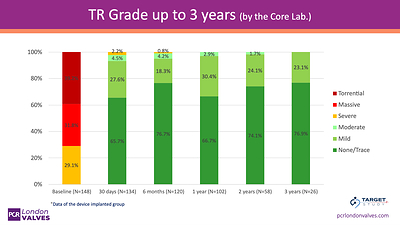
At 30 days, the study met its primary performance endpoint of successful implantation with ≤2+ TR. The elimination of TR was sustained up to 3 years, with 76.9% of patients achieving none/trace TR at the 3-year mark.
Furthermore, patients experienced durable improvements in functional status and quality of life early after implantation, which were maintained throughout the follow-up period:
- Functional Capacity: Significant improvements in the 6-minute walk test (6MWT) were observed, with a mean increase of +42 meters after 1 year.
- Quality of Life: Patients reported substantial improvements in their health status, with a +20-point increase in the Kansas City Cardiomyopathy Questionnaire (KCCQ) score at 1 year.
- NYHA Class: A marked shift toward NYHA Class I–II was observed over time, with 80% of patients in Class I or II at 3 years, compared to 39.9% at baseline.
- Right Heart Remodeling: The therapy demonstrated positive reverse right heart remodeling, with mean reductions at 3 years in IVC diameter (-25%), mid RVEDD (-22%) and basal RVEDD (-11%).
Favorable Safety Profile
The primary safety endpoint, a composite of Major Adverse Events (MAEs) at 30 days per TVARC definition, was met, demonstrating a favorable safety profile in this high-risk population. At 30 days, all-cause mortality was 5.7%, HF rehospitalization was 1.9% and major access site and vascular injury requiring surgical intervention was 5.1%. Notably, the study demonstrated favorable safety improvements with the Enhanced Delivery System (DS) compared to the 1st Generation DS, including reduced rates of major bleeding (5.0% vs. 21%) and major vascular complications (3.0% vs. 8.8%).
Prof.
Based on these compelling clinical results, Cardiovalve TR System is in the final stages of preparation for regulatory milestones. The company continues to advance its regulatory process toward CE Mark approval, with potential EU commercialization expected in the second half of 2027.
About Cardiovalve
A subsidiary of
About Venus Medtech
Venus Medtech (Hangzhou) Inc. (2500.HK) is a leading innovator in transcatheter heart valve solutions for structural heart disease. The company has developed a comprehensive product pipeline covering all four heart valves — TAVR, TPVR, TMVR and TTVR — and related accessory products. With global R&D centers in China, the United States and Israel, the company is committed to providing effective treatment solutions for life-threatening diseases.
 View original content to download multimedia:https://www.prnewswire.co.uk/news-releases/target-study-demonstrates-sustained-performance-and-favorable-safety-profile-of-the-cardiovalve-tr-system-in-high-risk-patients-with-severe-tricuspid-regurgitation-302947606.html

