GenScript Convenes AI, Biotech and Investment Leaders in London as Faster AI-Enabled Drug Design Raises the Stakes for Biological Evidence
Industry leaders point to better data, faster learning cycles and closer connections between computation and experimentation as critical to translating AI-designed molecules into development decisions
That was the central proposition
From
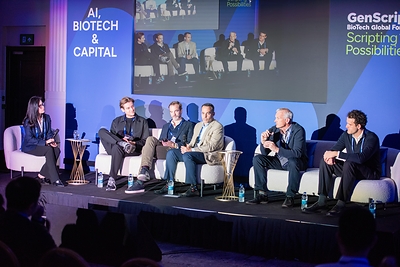
Panelists included Alan Belicha, PhD, Senior Director, Ecosystem Growth and Contributor Partnerships at Eli Lilly and Company;
Their discussion highlighted three forces shaping the next phase of AI-enabled drug discovery:
AI is moving into harder biology. Kohl described how quickly AI-enabled protein design is evolving, with the field moving beyond binding toward more complex modalities and questions of developability. Even with that progress, he said, the critical gap lies between generating a promising binder and developing a candidate a company is prepared to advance toward the clinic. Closing it requires addressing biological properties that are harder to model and more difficult to characterize experimentally. "This is all about building AI platforms that advance our partners' portfolios, our partners' programs," added Kohl. "Increasingly, we're betting on both building generative models and the agents around them to create end-to-end workflows. I think that's the exciting moment in time. It feels a lot like what GPT-3 felt like in language. That's what this field is now undergoing, and we couldn't be more excited for what's to come over the next one to two years."
Data quality and biological relevance are becoming more important. Panelists pointed to two related gaps: the need for datasets that support biologically relevant predictions, rather than simply more data, and the need for people who can bridge AI and wet-lab biology. As models take on harder biological questions, closer connections between dataset design, experimentation and computation will be critical to generating evidence that improves predictions and informs development decisions.
Capital follows evidence, not design volume. Pearce noted that AI is becoming effective at specific discovery tasks and could allow companies to reach the clinic with less capital than a traditional biotech would need. Long-term value, however, will depend on whether promising molecules can progress beyond design and through development, where biological and ultimately clinical evidence determines which ones move forward. As candidate generation accelerates, the evidence behind each candidate becomes more consequential in determining where development resources and capital are committed. "Ultimately, we're all paying for healthcare, and healthcare costs keep going up. And most development costs are actually going toward drugs that fail; the industry needs to think differently so that environment can change," Pearce added. "I think we're at the point where, with a better understanding of patient biology and stratification, new business models will evolve. Compared to other industries that have changed business models, the pharma industry is still doing the same thing it did 70 years ago: discovering a compound, doing a clinical trial, and hoping it works. In 20 years' time, I think that will have changed – and we will know that a new therapy works for a specific individual."
Turning Faster Design into Faster Learning
For
The shift is already reflected in
"The data we generate has two important purposes: to help advance promising candidates and to feed what we learn back into the next cycle," said Chen. "As AI allows us to explore more targets, modalities and deeper biology, generating decision-ready data becomes even more important. AI advances discovery. Biology advances AI.
From
"This conversation doesn't stop in
About GenScript Biotech Corporation
Founded in 2002 in New Jersey, GenScript Biotech Corporation accelerates innovation in biotech and healthcare by providing researchers and companies with the building blocks needed to develop groundbreaking treatments and products. As a cornerstone of the global life science ecosystem, GenScript actively collaborates with a diverse network of partners – from academic institutions to industry leaders – to co-create cutting-edge solutions that redefine service excellence. Guided by its mission to Make People and Nature Healthier Through Biotechnology, GenScript has become a trusted global partner with a team of 6,100+ employees, supporting over 200,000 customers across 100+ countries and regions, including the world's Top 20 pharma companies. For more information: www.genscript.com.
Media Contact:
Kate Grusich, GenScript Biotech Corporation
Katherina.Grusich@genscript.com


 View original content to download multimedia:https://www.prnewswire.co.uk/news-releases/genscript-convenes-ai-biotech-and-investment-leaders-in-london-as-faster-ai-enabled-drug-design-raises-the-stakes-for-biological-evidence-302950857.html

